
Showing posts with label Egypt. Show all posts
30.3.13
Hurghada | Egypt

 Hurghada was established in the early 20th century, and until a couple of years back, remained a minor angling village. However today, it has gone onto ended up being the preeminent visitor resort of the Red Sea coast and an universal community for sea-going dons. Depending on if it occurs in or on the water you can do it here: windsurfing, cruising, remote ocean-ocean angling, swimming, in any case, most importantly, snorkeling and swooping. The exceptional underwater arrangements seaward are a percentage of the finest on the planet, legitimately really popular right around jumpers. The warm waters here are perfect for numerous assortments of uncommon fish and coral reefs, which might additionally be watched through glass bottom watercrafts. This range has numerous fine housing, ordinarily offering warm and powerful aid. Restaurants are chiefly along the principle way. While in Hurghada, don't miss the gallery and aquarium, with their complete gatherings of verdure of the Red Sea.
Hurghada's first vacation spots incorporate its excellent beaches, which have long been a major drawcard in the town and gloating white, fine sand and numerous marvelous seaside perspectives, with numerous shores being spotted alongside lodgings. Other top vacation spots in Hurghada might be the vibrant and rather colourful neighborhood business sector of Bazaar in Ed-Dahar, the marine life at the Red Sea Aquarium, and moreover the numerous underwater attractions and breathtaking coral reefs at the Giftun Islands.

Near Hurghada you will discover a considerable lot of Egypt's top vacation destinations and overwhelmingly wonderful resorts. An especially favourite is Sharm el Sheikh, which lies close by the Gulf of Aqaba and is celebrated internationally for its scuba plunging and sandy sunny shores, while on the south-western side of Hurghada, the common capital of Qena holds an especially awe inspiring temple complex. Moreover inside achieve of Hurghada, the city of Luxor is without equivalent and full of wonderment-landmarks, for example the Valley of the Kings.
Hurghada is impeccable for those looking for sum unwinding with fabulous climate and warm ocean temperatures all through the year. It is quick developing into a major occasion resort, stuffed full of attractions, and a developing notoriety as a global end of the line for guests from all corners of the globe.

Hurghada developed from a modest angling village of a couple of hundred souls into a blasting town of over 150,000 individuals, who saw a chance to profit. Case in point individuals from the vacationer towns like West Bank, where inhabitants used the sum of their lives managing visitors. However, they made the right dessision by moving in Hurghada. Exceptionally soon this spot transformed into a gold mine. Voyagers continued advancing, and the occupants got reacher. As the town developed and improved, there were all the more chances for fortune.

Hurghada, Egypt

Hurghada Hotel

Hurghada
Read More »
Labels:
Egypt
18.6.11
The Abu Simbel temple Egypt
In 1257 BCE, Pharaoh Ramses II (1279-13 BCE) had two temples carved out of solid rock at a site on the west bank of the Nile south of Aswan in the land of Nubia and known today as Abu Simbel. Long before Ramses II, the site had been sacred to Hathor of Absek. The temple built by Ramses, however, was dedicated to the sun gods Amon-Re and Re-Horakhte. Because of their remote location near the Sudanese border in sourthern Egypt, the temples were unknown until their rediscovery in 1813. They were first explored in 1817 by the Egyptologist Giovanni Battista Belzoni.
The sacred area, marked out as a forecourt and bounded on the north and south sides by brick walls, occupied a place between the sandstone cliffs and the river. Ramses' temple was cut into the face of the cliff, before which is a rock-cut terrace. The temple is approached across this terrace up a flight of steps with an inclined plane in the middle, and enclosed on either side by a balustrade behind which stood a row of hawks and statues of Ramses in various forms.
The rock-cut fa açade of Ramses' temple represents the front of a pylon in front of which are four colossal seated figures of Ramses. This facade is one 119 feet wide, and 100 feet high, while the colossal statues are 67 feet in height. At the top of the pylon, above the cornice, is a row of baboons, who, as Watchers of the Dawn, are shown with their hands raised in adoration of the (rising) sun. The Egyptians believed baboons played a role in helping the sun god Ra defeat the darkness of night and so were believed sacred to the worship of the rising sun.


The sacred area, marked out as a forecourt and bounded on the north and south sides by brick walls, occupied a place between the sandstone cliffs and the river. Ramses' temple was cut into the face of the cliff, before which is a rock-cut terrace. The temple is approached across this terrace up a flight of steps with an inclined plane in the middle, and enclosed on either side by a balustrade behind which stood a row of hawks and statues of Ramses in various forms.
The rock-cut fa açade of Ramses' temple represents the front of a pylon in front of which are four colossal seated figures of Ramses. This facade is one 119 feet wide, and 100 feet high, while the colossal statues are 67 feet in height. At the top of the pylon, above the cornice, is a row of baboons, who, as Watchers of the Dawn, are shown with their hands raised in adoration of the (rising) sun. The Egyptians believed baboons played a role in helping the sun god Ra defeat the darkness of night and so were believed sacred to the worship of the rising sun.

The Abu Simbel temple

The Abu Simbel temple

The Abu Simbel temple

The Abu Simbel temple

The Abu Simbel temple

The Abu Simbel temple
Read More »
Labels:
Egypt
12.6.11
The Egyptian Pyramids, Egypt Pics 2011
There are about 110 pyramids currently known in Egypt, many in a state of great disrepair and almost unrecognisable. Some were built as burial places for kings and others for queens. A pyramid also may have represented a stairway for the king to ascend to the heavens. Another possibility is that it was symbolic of the primeval mound on which the sun god/creator was born.
How the Egyptians managed the complex organisation of labour and the physical movement of large stone blocks is still a matter for debate. Pyramid construction may have involved ramps being erected around the pyramid. Blocks of stone would have been pulled up on sledges and the ramps dismantled later. It is believed that most of the labour for the construction of the pyramids would have come from farmers who were available during the inundation season when the Nile River flooded and farmland was underwater. It would also have been an ideal time for the transportation by boat of large stone blocks from their quarries to the pyramid sites.


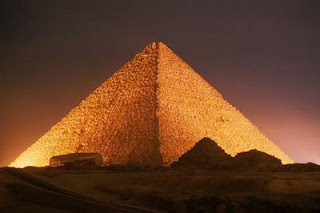


How the Egyptians managed the complex organisation of labour and the physical movement of large stone blocks is still a matter for debate. Pyramid construction may have involved ramps being erected around the pyramid. Blocks of stone would have been pulled up on sledges and the ramps dismantled later. It is believed that most of the labour for the construction of the pyramids would have come from farmers who were available during the inundation season when the Nile River flooded and farmland was underwater. It would also have been an ideal time for the transportation by boat of large stone blocks from their quarries to the pyramid sites.

The Egyptian Pyramids

The Egyptian Pyramids

The Egyptian Pyramids

The Egyptian Pyramids

The Egyptian Pyramids

The Egyptian Pyramids

The Egyptian Pyramids

The Egyptian Pyramids

The Egyptian Pyramids
Read More »
Labels:
Egypt
Subscribe to:
Posts (Atom)


