
Showing posts with label China. Show all posts
19.1.13
The Forbidden City | Beijing China

 The Forbidden City, likewise named the Palace Museum, apportions the respect of being one of five globe-celebrated internationally castles with the Palace of Versailles in France, Buckingham Palace in England, the White House in the U.S. furthermore the Kremlin in Russia. The castle, the most eminent and wonderful royal residence perplexing in China, was recorded as a World Cultural Heritage Building in 1987. It was constructed in the Ming Dynasty (1368-1644) and the development of this assembly of edifices took fourteen years from 1406 to 1420. In the Ming Dynasty and the Qing Dynasty (1644-1911), it was the royal residence where twenty-four heads climbed the throne and practiced their solid power to the country.
The destination of the Forbidden City was arranged on the Imperial City throughout the Mongol Yuan Dynasty. Upon the foundation of the Ming Dynasty, the Hongwu Emperor moved the capital from Beijing in the north to Nanjing in the south, and requested that the Yuan castles be torched. At the time that his child Zhu Di came to be the Yongle Emperor, he moved the capital back to Beijing, and development started in 1406 of what might end up being the Forbidden City.
The Forbidden City is a rectangle 961 metres (3,153 ft) from north to south and 753 metres (2,470 ft) from east to west. It comprises of 980 surviving structures with 8,886 sounds of rooms. The Forbidden City is surrounded on several sides by royal enclosures. To the north is Jingshan Park, otherwise called Prospect Hill, a manufactured mount made from the soil unearthed to construct the canal and from close-by ponds.

The Forbidden City

Forbidden City China

Beijing Forbidden City

The Forbidden City Beijing

Nice View Of Forbidden City China
Read More »
Labels:
China
29.10.11
Nanjing | China
Nanjing is an age-old city with ancient features. It served as the capital for six ancient dynasties, and harbors some glorious remnants of times gone by. History has left the place numerous historical sites and heritage relics. While Nanjing is also a modern city with a lot of perfect nightlife and entertainment facilities, the famous as followed.

Nanjing , China

Nanjing , China

Nanjing , China

Nanjing , China

Nanjing , China

Nanjing , China
Read More »
Labels:
China
24.6.11
The limestone basins at Huanglong China
The limestone basins is in northern Sichuan Province, west-central China, in the southern part of the Min Shan Range about 230 km north of Chengdu. The Scenic Area is divided between two sites: Huanglong valley, 45 km northeast of Songpan town, which also includes the whole Fujiang river catchment above Shijiabao village; and the Muni valley, 15 km south-west of Songpan, which includes the catchments of the Zhaga travertine waterfall and the Erdaohai mineral lakes.
This is an outstanding karst landscape within the southern part of the Min Shan range which runs from the eastern huanglong_0_2Qinghai-Tibetan plateau down to the Sichuan basin. The Huanglong section of the reserve covers the catchment of 22 tributaries of the upper Fujiang River which has its source in Snow Mountain Ridge. The Huanglong valley itself is one of these tributaries. The slopes above the valleys are forested and steep, a spectacular example being the 15km long 700m deep Danyun Gorge of the Fujiang near Huanglong valley. Above the tree line the site is surrounded by mountains, their strata tilted into jagged peaks, three bearing glaciers, seven over 5000m high and all snow-covered for much of the year. The pyramidal summit of Xuebaoding (Snow-Treasure Peak) is permanently snow-covered and carries the easternmost glacier in China.
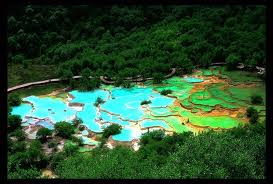


This is an outstanding karst landscape within the southern part of the Min Shan range which runs from the eastern huanglong_0_2Qinghai-Tibetan plateau down to the Sichuan basin. The Huanglong section of the reserve covers the catchment of 22 tributaries of the upper Fujiang River which has its source in Snow Mountain Ridge. The Huanglong valley itself is one of these tributaries. The slopes above the valleys are forested and steep, a spectacular example being the 15km long 700m deep Danyun Gorge of the Fujiang near Huanglong valley. Above the tree line the site is surrounded by mountains, their strata tilted into jagged peaks, three bearing glaciers, seven over 5000m high and all snow-covered for much of the year. The pyramidal summit of Xuebaoding (Snow-Treasure Peak) is permanently snow-covered and carries the easternmost glacier in China.

The limestone basins at Huanglong

The limestone basins at Huanglong

The limestone basins at Huanglong

The limestone basins at Huanglong

The limestone basins at Huanglong

The limestone basins at Huanglong

The limestone basins at Huanglong
Read More »
Labels:
China
20.6.11
Karstic peaks at Guilin, along the Li river China

Karstic peaks at Guilin, along the Li river

Karstic peaks at Guilin, along the Li river

Karstic peaks at Guilin, along the Li river

Karstic peaks at Guilin, along the Li river

Karstic peaks at Guilin, along the Li river

Karstic peaks at Guilin, along the Li river
Well-known both home and abroad for its verdant hills, limpid waters, fantastic caves and exquisite rocks, Guilin has enjoyed the reputation of having the country's most beautiful scenery for hundreds of years. Guilin is a bright pearl on the list of China's top tourist attractions and the Li River is the highlight of sightseeing tours in Guilin. Originated in Mao'er (Cat) Mountain in Xin'an county northeast of Guilin, the Li River winds its way southeast for about 426 km.Li River cruise takes visitors from Guilin to Yangshuo. A state-level scenic area, it is the centerpiece of your Guilin tour, as well as one of the highlights of any China tour. This section of the Li River appears like a classic Chinese ink painting with its green hills, crystal water, verdant bamboo and clear water reflection. The great Tang Dynasty poet Han Yu vividly described the landscape as "the river winds like a green silk ribbon, while the hills are like jade hairpins".
Read More »
Labels:
China
14.6.11
The Big Wall of China 2011
Most people tend to think that the Great Wall was a product of wars (actually of defense), thus its role ought to have been most closely related to battles and bloodshedding. It is, however, not that case. Most time under the Great Wall was actually peace rather than war; the Great Wall, in all times, was connected to the culture, foreign policies, and economy (just think how much could be spent on this super project). Philosophically, the Great Wall speaks well for a growth in the mixed soil of peace and war. It stands for some power, an unbeatable power despite all bitter conditions, known as the Great Wall Spirit among Chinese people.
Besides culture, policies and economy, another essential part that can't be divided from the Great Wall, which is the history of China. The Great Wall, whose building started more than 2,000 years ago, represents a main part of Chinese history, which has a profound influence on China today. So to speak, the Great Wall, in a sense, is history. And you will see that this tendency is reflected in our content. We generally talk about the Great Wall with dynasties who built it, along with events and social aspects of those dynasties, which may branch out as far as to other topics. In this manner of narration, It can be a little loose and sightly off the point, but we think it interesting, and it makes sense to put the Great Wall into the Chinese history.


Besides culture, policies and economy, another essential part that can't be divided from the Great Wall, which is the history of China. The Great Wall, whose building started more than 2,000 years ago, represents a main part of Chinese history, which has a profound influence on China today. So to speak, the Great Wall, in a sense, is history. And you will see that this tendency is reflected in our content. We generally talk about the Great Wall with dynasties who built it, along with events and social aspects of those dynasties, which may branch out as far as to other topics. In this manner of narration, It can be a little loose and sightly off the point, but we think it interesting, and it makes sense to put the Great Wall into the Chinese history.

The Big Wall of China

The Big Wall of China

The Big Wall of China

The Big Wall of China

The Big Wall of China

The Big Wall of China

The Big Wall of China
Read More »
Labels:
China
Subscribe to:
Posts (Atom)


